
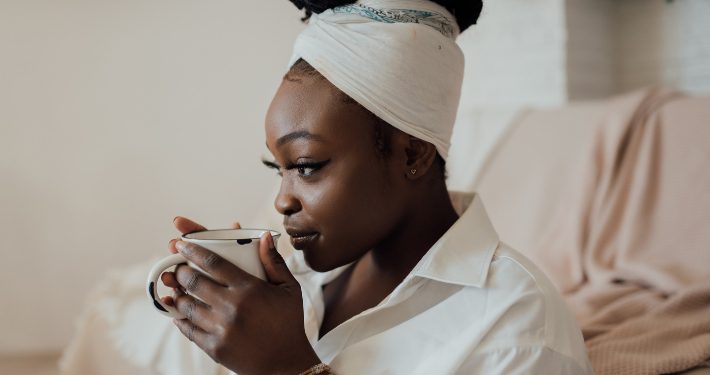
23 Jul Saying Yes to Yourself in a Culture of Self-Sacrifice
By Amina Diouf
Editor’s Note
In a world where women are so often expected to pour endlessly into others, the idea of pouring into oneself can feel radical, sometimes even wrong. But we believe it is not only necessary, it is urgent. Across the continent, we are witnessing a quiet uprising: women choosing themselves, not out of selfishness, but out of wisdom.
This piece is an invitation.
To pause.
To question inherited expectations.
To consider that your needs, dreams, and desires are not in competition with your culture, they may, in fact, be the most powerful way to serve it.
At Edit, we write for the woman who is learning to say yes to herself whether for the first time or the fiftieth. May this article meet you where you are and gently remind you: YOU ARE ALLOWED TO GROW.
Mariam stood in her kitchen, the scent of a simmering stew filling the air, her phone buzzing beside her. It was a reminder for the online coaching session she had booked two weeks ago…her first bold step toward finally writing the book that’s been whispering to her for years. But as she looked at the pot and then at the unread message from her cousin asking for help with the children, she hesitated.
Saying yes to herself felt unnatural. Heavy with guilt.
Across the African continent, many women grow up watching their mothers, aunties, and grandmothers put their own needs last. Whether it’s education, health, rest, or ambition someone else’s dream or crisis always seems to come first. The culture of caregiving runs deep, wrapped in love, responsibility, and cultural expectation. But somewhere in that well-meaning tradition, many of us are taught that sacrifice is the only proof of womanhood. That to be a “good woman,” you must disappear into the needs of others.
But what if we’ve misunderstood what strength really means?
What if saying yes to your own growth isn’t a betrayal of your duties, but a powerful act of vision and service?
The Burden of Being “Good”
In many African cultures, womanhood is often tied to how much we give. A woman is celebrated for her endurance, her silence in the face of hardship, her ability to hold the family together behind the scenes. Her love is proven through sacrifice, and her value measured in how well she serves everyone but herself.
But what happens when she wants something for herself?
A degree. A business. A creative project. A solo trip. A divorce. A rest.
Too often, she’s met with judgment. Or worse, silence.
“She’s changed.”
“She’s forgetting her culture.”
“She thinks she’s better.”
“She’s selfish.”
We hear these whispers in churches, mosques, marketplaces, WhatsApp groups, and family gatherings. The unspoken rule is clear: a woman should not desire too loudly.
So we wait. We postpone the book, the class, the plan, the healing. We tell ourselves we’ll return to it after the children are grown, after the house is built, after our husband is okay.
But “after” often becomes never.
What If Strength Looks Different?
The biggest lie many women are told is that endurance equals strength. That suffering without complaint makes you noble.
But what if real strength is something else entirely?
What if true strength lies in the courage to grow?
A woman who says yes to herself is not weak. She is awake. She is choosing to live fully, not in fragments.
She is choosing to trust that her life matters, not just as a support system for others but as its own, radiant story.
Self-Development Is an Act of Service
There’s a quiet shift happening across the continent. Women are enrolling in courses, attending coaching programs, launching passion projects, building businesses, leaving relationships that no longer serve them. They are reclaiming their right to grow and in doing so, they are reshaping their communities.
Because when a woman grows, everyone benefits.
A woman who goes to therapy raises emotionally healthier children.
A woman who invests in her skills uplifts her family’s future.
A woman who sets boundaries teaches others how to treat her.
A woman who finds joy makes room for everyone else to breathe.
Self-development is not selfish. It is strategic. It is a ripple effect.
You don’t become less of a woman when you choose yourself, you become more of who you were meant to be.
Boundaries Are Courage, Not Coldness
Saying yes to yourself is not just about big decisions. It’s also about everyday moments of bravery.
It’s saying no to an invitation when your body needs rest.
It’s carving out time for learning instead of overextending.
It’s choosing to keep your money for your dream instead of rescuing someone yet again.
It’s declaring, “I am worthy of investing in myself.”
These moments don’t make you cold or distant. They make you conscious.
And a conscious woman is powerful. She doesn’t run on guilt. She runs on clarity.
What Will We Teach the Next Generation?
What do we want our daughters, nieces, and younger sisters to learn from us?
That womanhood means burnout? That love equals self-denial?
Or that it’s possible to be committed to family and committed to self?
That you can nurture others without neglecting your own soul?
The girls are watching. So are the boys. And the future is being shaped by what we model, not just what we say.
When we show that boundaries are healthy, that joy is sacred, that self-respect is non-negotiable; we raise a generation that will honor those values too.
Rewriting Love
Too many of us were raised to believe that love looks like loss.
Loss of identity. Loss of dreams. Loss of rest.
But that’s not love. That’s a slow erasure.
Real love includes you in the equation.
It is expansive, not depleting.
It makes room for your needs, your healing, your joy.
And saying yes to yourself doesn’t mean abandoning others. It simply means including yourself in the circle of your own care.
Yes to that new dream.
Yes to stepping back.
Yes to stepping forward.
Yes to becoming someone more alive than you’ve ever been.
The world does not need more exhausted women.
It needs more women who are well, whole, and awake.
Say yes to yourself. Not tomorrow. Not one day. Now.
Amina Diouf
Editor of Edit – The Journal of The Third
Amina curates personal narratives that reveal the often-hidden strength, softness, and complexity of women’s lives. Through her work at Edit, she invites us all to read a little deeper into ourselves and each other.


Aucun commentaire